
SUGUTA VALLEY
ITINERARY
From the wildlife plains of Laikipia, we head north west into the Great Rift Valley. Our first stop is on the summit of the Silale crater. We then drop down into the Suguta Valley.
The landscape is constantly changing - desolate salt plains, lava flows and crocodile pools, through the colorful ‘painted’ and ‘hoodoo’ valleys.
Our most northern destination is the Sand dunes of the Suguta, where we touch down to take in these remote desert landscapes and jump down the sand dunes.
We return through the Ndotos and Mathews - a dominant mountain range that rises from the arid plains, with mist forests and ancient cycads on its summit. A completely new landscape to our earlier route. Our final leg takes us low level over the savannahs of Samburu.



LAIKIPIA + SILALE CRATER
There is no landscape in Kenya, outside of National Parks, more crucial for the future of elephants than Laikipia. 7,000 elephants are protected by private and communal landowners and a network of inspiring conservation organizations.
The Silale crater is a vast caldera, carpeted by grasses and shrubs, located at the southern tip of the Suguta Valley. It is here where the Pokot tribe live. Stop on the edge of the crater to meet the Pokot tribe and allow them to showcase one of there spectacular traditional dances.


SUGUTA VALLEY
Geologists have long been fascinated with this part of the Great Rift Valley. They have studied ancient sediments and fossil remains, and pieced together the history of a lake that rose and fell multiple times over the past 18,000 years.
Within the Suguta Valley - adding to the incredible diversity of landscapes, are the extensive and empty Suguta sand dunes. Spectacular and constantly changing with strong winds, they lend themselves to a perfect helicopter landing pad.


THE PAINTED + HOODOO VALLEY
This picturesque valley is characterized by dramatic rock formations protruding several hundred feet from the valley floor, where troops of Olive baboon and the Greater Kudu antelope find refuge.
Layers of mineral-rich red and orange rock features, heavily eroded and cut through by the seasonal streams.


CROCODILE POOLS
Lake Logipi, a seasonal saline lake - often full of flamingo - lies at the southern end of Lake Turkana. The lake is about 6km wide by 3 km long, and very shallow.


THE NDOTOS, THE MATHEWS + SAMBURU
The Ndoto and Mathews are iconic landmarks, yet their remote location has kept them secret and inaccessible to most. The range, separated by the Milgis river lugga, has montane forests, dramatic cliff faces, grassy glades and captivating views.
Samburu stretches from Laikipia and the Ewaso Nyiro River, to the southern end of Lake Turkana. The Ewaso Nyiro River flows constantly, cutting through the heart of Samburuland - it represents life for the people, livestock and wildlife of the arid north.

END OF YOUR SAFARI

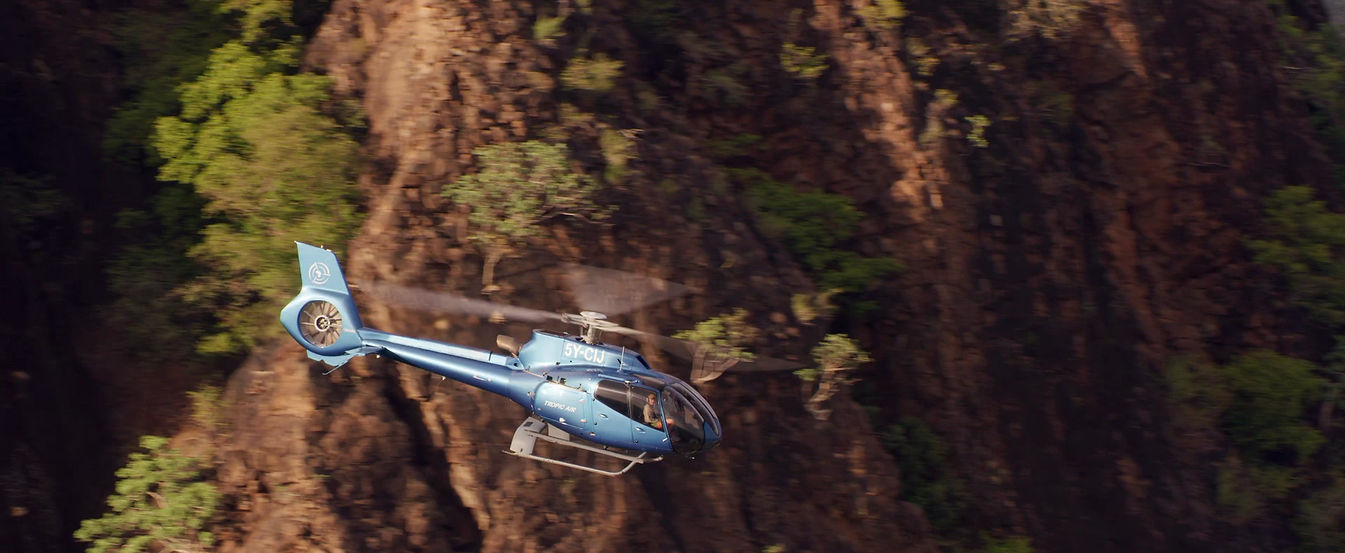
Tropic Air is based in Kenya, and offers a broad range of professional air services using helicopters and fixed wing aircraft, throughout sub-Saharan Africa.
Areas of operation: 16 African countries, covering more than 10 million square kilometers: Kenya, Tanzania, Uganda, Congo, Chad, South Sudan, Somalia, Ethiopia, Rwanda, Madagascar, Mozambique, Zambia, Malawi, Zimbabwe, Botswana and Namibia.